"ninjatrader margin" - Google News
[unable to retrieve full-text content] NinjaTrader Review 2026 Investing.com
This Cryptocurrency Just Surpassed Bitcoin In One Key Adoption Metric - Forbes |
| This Cryptocurrency Just Surpassed Bitcoin In One Key Adoption Metric - Forbes Posted: 30 Sep 2019 07:10 PM PDT  (Photo by S3studio/Getty Images) 2018 S3studioThroughout the history of cryptocurrencies, altcoins have had a lot of trouble competing with Bitcoin, which is basically the gold standard of the market. In terms of everything from network effects to brand recognition, there is still simply no real threat to Bitcoin's position at this time. That said, Ethereum briefly passed Bitcoin in one key area last week: total daily USD-denominated transaction fees. In fact, Ethereum miners collected more in fees than Bitcoin miners on this past Saturday and Sunday too, according to Coin Metrics. Additionally, while it's been a rough September for the Bitcoin price, Ether is in the green (just barely) this month, and the cryptocurrency recently enjoyed one of its best 24-hour Bitcoin-denominated price moves ever recorded. Increased Usage Means Higher Fees In cryptocurrency networks, transaction throughput is limited in order to preserve decentralization. If the network is processing too many transactions per second, the users' ability to run their own full nodes and check that no one is cheating will be harmed. Since the whole point of using a public blockchain is to gain properties like censorship resistance and trust minimization, avoiding centralization is key. Due to the limitations placed on capacity, cryptocurrencies like Bitcoin and Ethereum see higher transaction fees when the networks become congested. This is exactly what has happend with Ethereum over the past month, as total daily USD-denominated transaction fees hit levels not seen in over a year. So, what has caused the recent spike in Ethereum transaction fees? It appears the blame can be placed on a Ponzi scheme-esque game called FairWin, which also has a critical vulnerability in its associated contract on the Ethereum blockchain. According to ETH Gas Station, FairWin has recently accounted for roughly a third of the activity on the entire Ethereum network. The spike in FairWin's popularity, according to Etherscan, correlates almost perfectly with the increase in total fees seen on the Ethereum network this month, according to Coin Metrics. 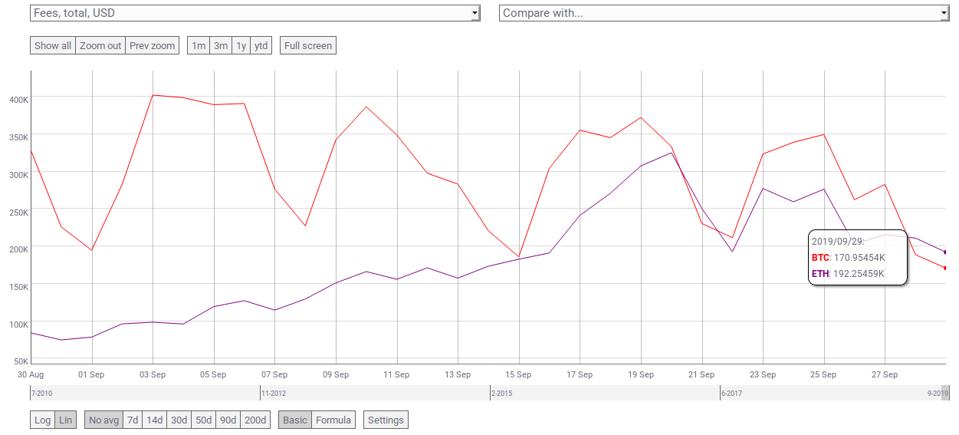 Total USD-denominated transaction fees per day for the Bitcoin and Ethereum networks. Coin MetricsWhat Does This Mean for Ethereum's Future? The total value of all the transaction fees paid on a cryptocurrency network every day is a key metric to watch because it illustrates the level of demand for that particular blockchain. If people are willing to pay relatively high fees to use a particular blockchain, they must be getting some sort of utility out of it. Additionally, fees are intended to eventually replace the creation of new Bitcoin as the incentive for miners to secure the network. Things will likely work differently for Ethereum, as the Ether token is expected to be issued on a perpetual basis, which means a never-ending block subsidy. This is effectively a trade-off of dilution of the current Ether supply in exchange for a higher level of network security. In terms of their possible effect on the Ether price, it's unclear if fees are an important metric to watch. While total fees can be a useful indicator of the amount of real activity on a cryptocurrency network and provide a greater incentive for miners or stakers to secure the network, this data point doesn't necessarily have much to do with the native token of the network. This point is especially true when it comes to Ethereum, as that blockchain is often used to issue and transfer non-native tokens. At the end of the day, it does not seem clear that a popular Ponzi scheme game or the movement of something like Tether USD means people should be buying and holding Ether over the long term. And as Castle Island Ventures Partner Nic Carter recently explained, a cryptocurrency increases in value when users decide to hold the asset for long periods of time rather than utilize it as a sort of appcoin. It is perhaps the market's realization of this point that was behind Ether's 85% drop against Bitcoin since the peak of the hype around the altcoin becoming the largest cryptocurrency (measured by market cap) back in June 2017.  |
| Posted: 30 Sep 2019 04:30 AM PDT  Trust is the fundamental element in business transactions. It is what keeps economies and societies functioning. Throughout history, we have managed to build complex institutions from legislative, judicial, law enforcement to banks and various financial institutions to enable trust in commercial transactions. We also invented tools such as fiat money, bonds, stocks and contracts to guarantee the successful execution of business transactions. And then came Bitcoin and its blockchain technology that allowed two parties to exchange value with trust without legislative institutions, fiat money, banks or contracts. It is, simply, a revolutionary technology. This is probably why blockchain was hyped as the "next generation of the internet" that will create "the programmable economy." (Full disclosure: I own bitcoins and have a small investment in Facebook.) Despite the many successful implementations of blockchain, it has not been as transformational and didn't generate the much-hyped benefits. One reason is that blockchains are implemented as disconnected solutions with no foundational protocols such as TCP/IP, HTTP and HTML that created the internet revolution. Additionally, no single blockchain network emerged as the dominant one that would offer a multitude of business services to produce the desired transformational benefits. Enter Facebook's Libra cryptocurrency and blockchain. On June 18th, Facebook announced the Libra blockchain and cryptocurrency, which raised many questions: What is Libra and how will it work? Is it a cryptocurrency? Is it a blockchain? Will it overtake Bitcoin and Ethereum? Will consumers trust it? What is its potential? What's in it for Facebook? And will Libra become the unifying and transformational blockchain that everyone was hoping for? The Libra whitepaper holds some answers to the above questions, including how it will be governed. Libra will be launched by the Libra Association, which is an independent, nonprofit membership organization, headquartered in Geneva, Switzerland. Libra will be governed and controlled by this association and will be independent of Facebook. It is currently composed of 28 organizations. The key difference between Libra and Bitcoin is the permissionless versus permissioned blockchain. Simply put, a permissionless blockchain implies that anyone with the right hardware infrastructure can apply the mining protocols and participate in validating transactions and in becoming a validating node on the Bitcoin network. Currently, Bitcoin has over 9,500 nodes, which enabled it to withstand the test of time and produce an immutable, distributed and secure ledger. In contrast, Libra is going to be a permissioned blockchain that is centralized where its consensus mechanism, software and governance are controlled by Libra Association members who are the only ones permitted to validate transactions. At launch, the Libra blockchain will have 100 permissioned organizations. Visa, Mastercard, Uber, Vodafone and Spotify are among the founding companies of the Libra Association. So, is Libra a cryptocurrency with a blockchain like bitcoin? Well, Libra applies many of the same building blocks and concepts as Bitcoin. It uses a blockchain, cryptography, digital wallets, anonymous accounts, smart contracts and the gas concept with a new programming language called "Move." This makes Libra more like Ethereum than Bitcoin. Libra will be implemented as a stable cryptocurrency by pegging it to a basket of "low volatility" assets such as the dollar, euro, yen and bonds, and through creating the Libra Reserve. This reserve allows the 100-node consortium to "mint" and destroy Libras as needed and based on demand. So, when customers buy Libra coins using dollars, those dollars are put into the reserve that is then invested in low volatility assets. This fund concept is missing from Bitcoin and Ethereum, which leads to their price swings and speculations and makes Libra a powerful contender to Bitcoin, Ethereum and other cryptos. Libra is also being architected with some advantages over traditional cryptocurrencies. It will consume far less electricity than Bitcoin and is touted to have a higher throughput of 1,000 transactions per second (TPS) compared to bitcoin's seven TPS and Ethereum's 15 TPS. It also promises to make sending money across the globe as easy as texting and will have very low fees compared to close to 5% of the transaction value of international wire transfers. Furthermore, Libra has the potential of helping many of the 1.7 billion unbanked to enter the global financial system. It could trigger a wave of innovation in financial services as much as the internet did for online services. These are some remarkably important advantages for Libra that could possibly offer the transformation that has been expected from blockchain and cryptocurrencies. With Facebook's 2.4 billion users across the globe, Libra has the potential of transcending governments and central banks and possibly becoming an international digital currency. If Facebook's users adopt Libra to shop, transfer money and transact, it could make Facebook one of the most powerful financial institutions in the world. "That would herald a consumer revolution — but could also make financial systems less stable and reduce governments' economic sovereignty, " writes The Economist. It's clear that Facebook's Libra has "legs" but also some serious challenges. Aside from the technological challenges of delivering the Libra network with the advertised throughput, security and smart contracts, there are questions on whether a 100-node blockchain network can be immune to global outages and to denial of service attacks. In addition, how will a 100-node permissioned blockchain move into a permissionless one within the planned five years, and maintain the promised 1,000 TPSs? Will consumers accept it as a slower alternative to credit card processing that is at some 1,700 TPS? Finally, it is not clear when Libra will be available and how will it be rolled out. But, more importantly, Facebook needs the blessing of governments across the globe and the trust of its customers. These are two enormous obstacles that Facebook would need to overcome. It is by this fundamental trust from governments and from consumers that would define the future of Libra and possibly of Facebook. So, can Facebook address these two trust problems and use Libra to solve its own low level of trust from consumers and governments?  |
| Posted: 30 Sep 2019 06:33 AM PDT  Coinbase co-founder and CEO Brian Armstrong speaking at TechCrunch Disrupt SF 2018. Steve Jennings | Getty Images for TechCrunch Cryptocurrurrency exchange operators including Coinbase, Kraken and Circle have teamed up to create a system that rates digital tokens on how close they are to securities. The points-based rating system, unveiled by Coinbase in a blog post Monday, determines whether a digital asset falls under U.S. securities law using guidance from the Securities and Exchange Commission. "The result of the analysis is a score which makes it easy for members to synthesize the analysis across many tokens and make their own, independent business decisions about whether or how to support an asset," Coinbase said in the blog post. The framework was established by a newly formed organization set up by the firms, called the Crypto Rating Council. It's aimed at helping financial services companies that are looking to add support for certain cryptocurrencies but are uncertain of their legal status. It rates digital tokens on a scale of one to five, one being an asset with few or no characteristics of a security, and five sharing the most in common with a security. Aside from Coinbase, Kraken and Circle, founding members of the council also include Anchorage, Bittrex, DRW Cumberland, Genesis and Grayscale Investments. The system addresses a key point of uncertainty that has dogged the cryptocurrency industry for some time — that is, whether digital assets like bitcoin can be counted as securities and subject to the regulations that come with that classification. Speculative investing in the space has heightened concerns over the potential risks to investors. At the height of the late 2017 cryptocurrency boom, so-called initial coin offerings were receiving huge attention from retail investors — with some getting burned along the way. According to the Crypto Rating Council's system, bitcoin and litecoin are least likely to fall under securities laws, while XRP is more akin to a security. That goes against what the CEO of Ripple — the firm using XRP for cross-border payments — has claimed, having gone on record saying it's not a security. The ratings also appear to be in line with SEC Chairman Jay Clayton's thinking. The regulator's chief has in the past said that cryptocurrencies like bitcoin aren't securities, but tokens like those bought in ICOs are. Some have argued that the likes of bitcoin are more similar to a commodity like gold or oil. "We expect that some ratings will change over time and we will accept and consider feedback from asset issuers when they want to share additional information or clarifications that may impact an asset's rating," Coinbase said.  |
| What Google's 'Quantum Supremacy' Means for the Future of Cryptocurrency - CoinDesk Posted: 30 Sep 2019 04:00 AM PDT  Just like that, the promise of quantum computers overtaking traditional computers is one step closer to reality. According to a recent report by the Financial Times, tech giant Google claims to have achieved "quantum supremacy," meaning it has built a quantum computer able to solve formerly impossible mathematical calculations. If proven true, this marks a major milestone in the development of quantum computers and possibly, the demise of blockchain technology as we know it today. Since the advent of bitcoin, the threat of quantum computing has motivated researchers, technologists and, now, governments, to build software able to resist attack by even the most powerful quantum computers. Quantum computers, while still largely theoretical, are thought to vastly speed up the process of solving complex computations. So much so that current calculations impossible for a current computer to solve in one human lifespan would take mere seconds for a quantum computer to crack. As explained by data research firm CB Insights, quantum computers rely on "naturally occurring quantum-mechanical phenomena" known as superposition and entanglement. "These states of matter, when harnessed for computing purposes, can speed up our ability to perform immense computations," said the report. Canada steps inAnd this summer, the National Research Council (NRC) of Canada partnered with the University of Waterloo to launch a two-year research initiative for quantum-safe blockchain technology. The research, led by University of Waterloo professors Srinivasan Keshav and Michele Mosca, is receiving a total of $180,000 over this two-year period to expand the team with other "highly qualified personnel," said Nic Defalco, communications advisor to the NRC. Among state governments, Canada is the leader in quantum computing research, according to Andersen Cheng, CEO of quantum R&D firm Post-Quantum. "Other governments are trying to play catch-up," said Cheng. "The U.S. is lagging behind quite a bit. The UK is putting a lot of money into quantum computing hardware and now, they're just about to start thinking about post-quantum software and cryptography." U.S. President Donald Trump signed the National Quantum Initiative Act into law last December, allocating $1.2 billion over a five-year period to activities promoting quantum information science. In June, the UK's National Quantum Technologies Programme received an additional $193 million of funding from the UK government, placing total investments in the program since 2014 at $1.2 billion. Why the fuss?Efforts in the private sphere are similarly increasing, according to CB Insights, which found the number of investments in private quantum computing startups has increased over 200 percent in the past six years. All this, in the mind of Adam Koltun of the Quantum Resistant Ledger (QRL) Foundation, speaks to a growing problem. "A decade ago people said it would take 50 years to get where we are now with quantum computing. Five years ago, they said it would take 25 years to get where we are now. So quantum computing has this nasty habit of exceeding people's expectations," said Koltun, adding:
Koltun's group claims to have built the first blockchain that is secure against attacks from quantum computers. Without proactive behavior to safeguard existing technologies from possible attacks, Koltun fears the future blockchain and cryptocurrencies – and also the internet at large – will be at risk. Cautionary taleThere are actually a few different ways a quantum computer can snap a blockchain. For one, blockchain transactions are secured with digital signatures based on elliptic curve cryptography (ECC). ECC coincidently is also used on the internet to encrypt user data and website traffic. However, ECC is not "quantum-safe," according to Post-Quantum's Cheng, meaning that a powerful quantum computer could theoretically decrypt user private keys and forge transaction signatures on their behalf. "Once that trust is broken, that will be the end of cryptocurrencies," said Cheng, adding:
This is by far the most pertinent security issue for blockchains when it comes to co-existing in a world with quantum computers – especially given that researchers and mathematicians are already aware of a possible algorithm, called Shor's algorithm, that could be used by a sufficiently powerful quantum computer to break elliptic curve digital signatures. "We've had the math available for us for decades in terms of what the first and second generation of quantum computers are going to look like," said the QRL Foundation's Koltun. At the same time, Koltun did contend that quantum computers may vastly exceed scientist's expectations and prove to make blockchain technology obsolete in ways not yet imagined. Said Koltun:
Fighting an enemy that doesn't yet existPrecisely because the full capabilities of quantum computers are not yet known, combatting their impact to existing blockchain platforms may sound like a doltish task. As frequently explained by prominent bitcoin evangelist and author Andreas M. Antonopoulos, the threat of quantum computing in his mind is often overplayed. "We can migrate quite easily to another algorithm," he said last year during one of his monthly Q&As. "It's not really as big a threat as people think it is." What's more, while the capabilities of quantum computers might be vastly more extensive than currently imagined, they may also be vastly overstated. "Google's quantum breakthrough is for a primitive type of quantum computing that is nowhere near breaking cryptography," said bitcoin core developer Peter Todd. "We still don't even know if it's possible to scale quantum computers." Still, if there's a general understanding that quantum computing will be a problem for blockchain networks moving forward, Keshav, the professor at the University of Waterloo, asks:
Keshav said his newly commissioned research team would be looking into a handful of the most promising "quantum-safe cryptography" tools, including lattice-based cryptography and multivariate public-key cryptography. His researchers will initially begin testing on the enterprise-focused Hyperledger Fabric blockchain. There are scores of others that the wider crypto space should be looking into, according to Keshav. Pointing to an ongoing competition hosted by the U.S. National Institute of Standards and Technology (NIST), Keshav said there have been over 80 different proposals submitted from researchers and academics for "quantum-resistant, public-key cryptographic algorithms." Having put forth his own proposal in NIST's ongoing cryptography competition, Post-Quantum's CEO Andersen Cheng said:
Model quantum computer image via Shutterstock  |
| You are subscribed to email updates from "what is cryptocurrency" - Google News. To stop receiving these emails, you may unsubscribe now. | Email delivery powered by Google |
| Google, 1600 Amphitheatre Parkway, Mountain View, CA 94043, United States | |

Comments
Post a Comment