"ninjatrader margin" - Google News
[unable to retrieve full-text content] NinjaTrader Review 2026 Investing.com
Cryptocurrency Will Not Die - GQ |
| Cryptocurrency Will Not Die - GQ Posted: 26 Nov 2019 07:01 AM PST  Money is life. For nearly every human being on the planet, it's more important than children, mom, art, whatever. Technically, it's a record of payment. It can be a currency, but it doesn't need to be. For an abstract idea, both real and unreal, money is quite tangible. Money means your kids eat or go hungry. Money enables a bag of paper to be exchanged for a house full of appliances. Money can be sex. Money can be murder. Say "money" three times fast and it feels like a marble of vanilla ice cream rolling around on your tongue. And money is all kinds of emotional. It's attached to self-worth, shame, and safety. The other morning I noticed my wallet had no more money in it, so I went to an ATM and a neurological reaction turned the feeling of ten pieces of paper in my hand into "happy," "more relaxed," "more secure," all at once. You may not know what money is, but you know what is money. But now money's changing, perhaps forever. What is crypto? A couple years ago, crypto was the future, according to your cousin at Thanksgiving. It had something to do with Internet drugs in China? He couldn't explain it very well; it sounded like another one of his schemes. But then, out of nowhere, crypto kind of was the future. Bitcoin bros the world over became millionaires. And then the bubble burst, everything went to hell, everyone consoled your cousin while breathing a sigh of relief, because crypto had disappeared, and none of you needed to figure out what the hell it had been. Only crypto didn't disappear, it just went quiet. And this Thanksgiving, the evangelists will tell you it's bigger, more relevant than ever, only they're not just your cousin anymore. They're the People's Bank of China. They're Mark Zuckerberg. Talking about crypto today is more like talking about the climate crisis. Forget real or unreal. It's "how soon," and "oh crap." Crypto is life. You just don't know it yet. The Rise and Rise of a Crypto King Brian Kim is real, but that's not his real name*. Kim immigrated to San Diego for graduate school in his early twenties. About a decade later, he is millennial in several ways that will be familiar to anyone watching recent sitcoms. He likes music and hanging out with friends. His parents have high expectations for him that he feels he does not quite fulfill. He doesn't like his job and isn't sure how it became his career, though it is lucrative: Kim is an elite academic coach with many clients who are wealthy, in some cases very, in a few cases ludicrously so, all of them quite happy to pay top dollar so their kids receive the best (legal) test prep that money can buy. *In addition to providing this person with a pseudonym, certain identifying characteristics have also been changed. Which is how Kim, by living in a small apartment ("very small"), minimizing his expenses, and subsisting on ramen packets for nearly a decade, managed to save a decent amount of money. And then suddenly become wealthy—very wealthy, even ludicrously so. Kim heard about crypto from a friend I'll call Derek*. "I think it was about 2013 or '14," Kim said. "[Derek] was like, 'Hey, I've been looking into this and I really think maybe we should invest in some Bitcoin.' " Kim was intrigued, but he didn't follow through. Like a lot of people, he'd heard about Bitcoin, the original crypto and still the OG, but it didn't sound fully real. Then, in 2017, he tried buying some "altcoins." An altcoin is essentially any cryptocurrency that isn't Bitcoin; in October 2019, a database listed over three thousand of them. Some improve on Bitcoin's core technology by offering more secrecy, or better security. Many are simply wannabes, copycats that inspire wildcat behavior, that get painted by the wide brush known as "shit-coin." Still, some alts have outperformed Bitcoin itself; in 2017, a coin called XRP rose by 36,000 percent.  |
| Posted: 27 Nov 2019 08:55 AM PST  NEW YORK — Cryptocurrency theft has surged in 2019 compared with last year, with more money flowing through digital exchanges and criminals looking to carry out bigger heists, according to a report from blockchain forensics company CipherTrace obtained by Reuters. Losses from digital currency crime soared to $4.4 billion in the first nine months of the year, up more than 150% from $1.7 billion in all of 2018. "The 150% increase in crypto theft and fraud reflects how criminals are adapting for bigger and better scores," Dave Jevans, CipherTrace chief executive officer, told Reuters. "Criminals chase money and the money is right here and ripe for the taking. Little attacks are often easy to defend against, but targeted attacks are far more lucrative," he added. Cryptocurrencies have attracted intense regulatory scrutiny around the world, as developers and market participants in the space seek to push this asset class into the mainstream. Two large thefts were the main drivers for the surge this year, CipherTrace said. One of the frauds saw users and customers lose $2.9 billion from an alleged Ponzi scheme involving crypto wallet and exchange, PlusToken. The other significant fraud this year was the $195 million that customers lost from Canadian crypto exchange QuadrigaCX following the unexpected of its 30-year-old co-founder and CEO, Gerald Cotten. "Even without the two biggest thefts and scams, we are still witnessing many multi-million dollar crimes," Jevans said. "There is a relatively consistent increase in criminal activity year over year and we don't expect that to change overnight." He added that crimes valued under $5 million are often underreported, as exchanges and police teams focus on the bigger more existential threats to businesses. CipherTrace reported that the sector saw just $15.5 million in quarterly thefts and scams in the third quarter, the lowest in two years. Jevans said that while the industry may be seeing fewer reported attacks, criminals were still making out with "bigger wheelbarrows of cash." CipherTrace had previously noted that the type of crime in the crypto sector had shifted from outright thefts to exit scams and other frauds perpetrated by insiders, which showed exchanges have become tougher for criminals to hack. "Today's attackers are patient and willing to spend more time waiting for a payout," said Jevans. "Not only have we seen more and more $100 million thefts and scams, those responsible are acting carefully, only cashing out small amounts to stay under the radar." The report also showed that of the top 120 global crypto exchanges, 65% have weak know-your-customer (KYC) requirements. "It will no doubt have implications as regulators seek to have KYC information shared globally," said CipherTrace. (Reporting by Gertrude Chavez-Dreyfuss; Editing by Bernadette Baum)  |
| Bitcoin fans spot Mr Robot easter egg, start sending ‘Elliot’ their cryptocurrency - The Next Web Posted: 27 Nov 2019 08:07 AM PST Eagle-eyed cryptocurrency fans spotted a Bitcoin BTC address in USA Network's Mr Robot and decided to start sending BTC. In the latest episode, vigilante hacker Elliot Alderson codes a program for "cleaning coins" with a "crypto tumbler." Presumably, he's looking to steal some Bitcoin, and wants to cash it out without being caught.  Elliot's mixer is likely to make tracking Bitcoin more difficult, much like popular BTC solution CoinJoin, which allows multiple users to shuffle coins with each other to hide their history. These programs have grown in popularity in response to the rise of analytic firms like Elliptic and Chainalysis over the past year. 'Elliot' has siphoned some Bitcoin alreadyIn the screenshot above, the auto-complete in Elliot's programming environment suggests a Bitcoin address: 1MbwAEKJCtPYpLPxEkUmZxwjk63nQrpbXo.  Plugging that address into Blockchain.com's explorer shows it's been featured in five BTC transactions since the episode aired on November 24. While the total amount sent to "Elliot" is pretty small, just 0.0044470 BTC ($32), what's curious is some of that Bitcoin appears to have been siphoned already. 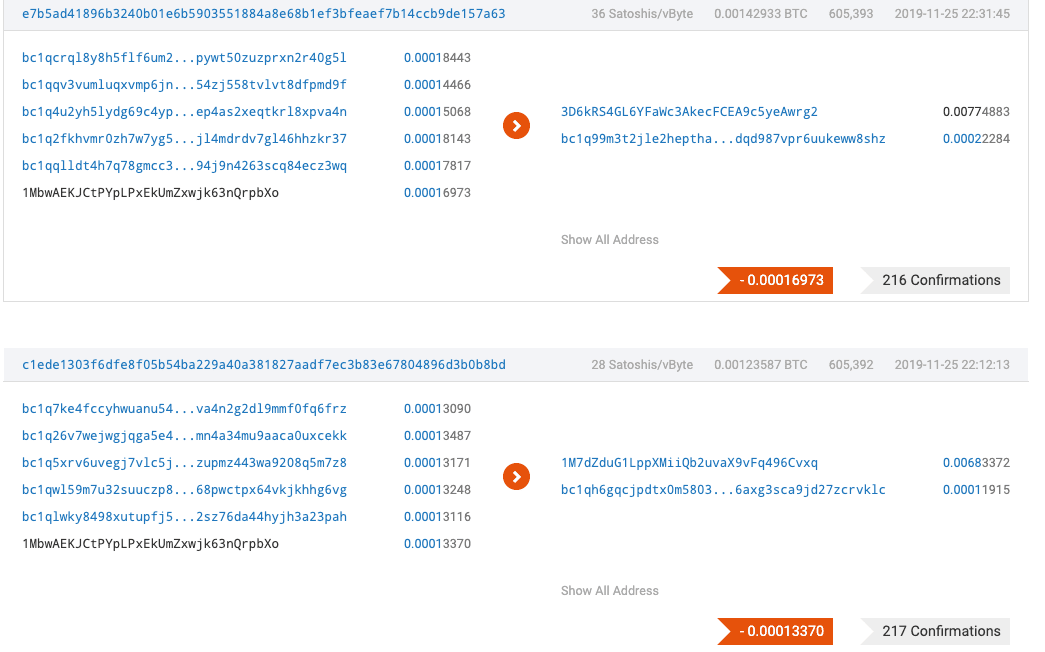 Indeed, whoever controls that Bitcoin address sent a combined 0.00030343 BTC ($2.20) to external addresses two days ago. Curiously, one of those addresses, a "multi-sig" wallet, has seen quite a bit of usage. Over the past few months, that address has received almost 1.5 BTC ($10.9K), and seen 350 transactions. It currently houses 0.94 BTC ($6.8K). What inspired these Bitcoiners to send money to a fictitious character isn't really clear. Considering how poorly price of Bitcoin has faired over the past week, let's just say it's for good luck. Published November 27, 2019 — 16:07 UTC  |
| Cryptocurrency exchange loses US$50 million in apparent hack - We Live Security Posted: 27 Nov 2019 08:08 AM PST  UPbit has announced that, as a precaution, all transactions will remain suspended for at least two weeks Cryptocurrency exchange UPbit announced today that it lost almost US$50 million worth of ether (ETH) in an apparent security breach. According to this statement by Lee Seok-woo, the CEO of the exchange's operator Dunamu, around 342,000 ETH were moved from the platform's 'hot wallet' to this unrecognized wallet today shortly after 1 p.m. local time. Client funds were not affected, said the South Korea-based cryptocurrency exchange. The incident was also noted on Twitter by Whale Alert, a service that tracks major cryptocurrency transactions.
UPbit said that, in the wake of the incident, it moved all virtual coins to cold wallets. Cold-storing is a method used for the long-term storage of cryptocurrencies offline in order to reduce the likelihood of funds being stolen. By contrast, hot wallets are connected to the internet and used to carry out transactions. The exchange has also halted all deposits and withdrawals and said that, in order to protect its clients' virtual funds, the transactions will remain suspended for two weeks. The exchange said that it will cover the loss from its own funds. Additional details are scarce; notably, there's no word on how the theft is thought to have taken place. Launched two years ago, UPbit went on to become one of South Korea's largest cryptocurrency exchanges. Just months ago, its users were targeted in a phishing campaign with a fake giveaway used as the pretense. Weeks earlier, another major South Korean cryptocurrency exchange, Bithumb, lost up to US$20 million worth of digital money in a suspected inside job. Indeed, recent years have seen a string of cyberattacks against providers of infrastructure that caters to virtual currencies and their users, including high-profile thefts of people's virtual money. Recent ESET research, too, discovered a range of mobile apps aimed at parting people from their cryptocurrency assets.  |
| You are subscribed to email updates from "cryptocurrency" - Google News. To stop receiving these emails, you may unsubscribe now. | Email delivery powered by Google |
| Google, 1600 Amphitheatre Parkway, Mountain View, CA 94043, United States | |


Comments
Post a Comment